This is a couple of pages on how I (Ron Robison) approach discipleship. Not a study or a program, just where I've landed after 40+ years of active discipleship. Everything I do takes its heading from two foundational principles:
- 1. The Compass points toward Christ, and everything else takes its bearing from there.
- 2. We only control our actions and attitudes as we journey through life as a disciple of Christ, and the outcomes and anything we attempt to control is in reality up to our Heavenly Father as He leads us via the Holy Spirit.
That sounds like a thing people say, but these principles are truly foundational. My health, my money, my work, my house, and my relationships each answer to those principles, and none of them gets to set its own framework to live by. When I get something wrong, it is almost always because one area quietly started steering my life. The compass I use has seven points to navigate by as I live out my discipleship journey with the Holy Spirit's guidance.
Discipleship is followership
Not a status, not a curriculum you complete, and not a decision you made once and can point back to. A disciple is someone who is following Jesus in the present tense, today, in the ordinary hours, as in a continual apprenticeship, not credential gathering or checking off an item on your to-do list. Which means the hard question is never am I a Christian; it is what did I actually follow today, as evidenced by what I did.
The Gap
The thing I keep coming back to, and it is the reason any of this exists, is that on Sunday you know your lines, who you are supposed to be, and you play the part well. On Monday the alarm goes off and you are someone else, short with your family, checked out at work, choosing comfort over obedience and your will over God's. The distance between the Sunday version and the Monday version is the Gap. And it is not really about two days of the week. It is the Gap between the disciple you present yourself to be and the one you actually are.
Most of what the church offers is designed to be joinable as we attend, give, serve, and belong. Those are good and I do them, but a person can clear that bar for thirty years while the Gap never closes because nothing in it ever requires an honest look at Monday. What I am describing asks more: a daily practice giving an honest account of where you are off-center, along with other people who are being permitted to keep you accountable. I am not interested in being harder on anyone. I am interested in the distance between casual and committed being crossable because right now there is very little in between, and the disciples who strive to be biblical disciples are mostly left to cross the Gap alone.
Seven points, one bearing
A compass with one direction is a needle. What makes it navigable is that it reads every heading against the one true north, and a life has more than one heading running at a time. So I navigate by seven points. Six of them are the territory: the body, the people around me, the money, the work, the projects in motion, and the systems I run my life on. Each one is a real area with real decisions in it, and each one answers to a single governing principle. It's not just symbolism; it means when I am off in one area, I already know which principle stopped steering.
The seventh is not one of the six. It is the ground the other six stand on: discipleship. It is not a slice of the pie competing with the others for a Tuesday. It is the lens I look at the other six through. Money is not a finance question first, it is a discipleship question wearing a finance coat. So is the calendar, so is the body and everything my journey through life is associated with.
This is the whole reason the arrangement works. Left alone, any one of the six will quietly promote itself and start setting the heading for the rest. The work does it most often. The money does it most quietly. The seventh as the foundation rather than a seventh slice is what keeps that from happening without my noticing.
The wobble is not the Gap
Every disciple lives inside three tensions at once.
- 1. Conviction and compromise - truth held firmly while extending grace to people who see faith differently.
- 2. Certainty and doubt - settled faith alongside honest questions.
- 3. Zeal and wisdom - passionate action against patient discernment.
You do not resolve these, you oscillate inside them. That oscillation is what I call the wobble, and the wobble is navigation, not failure. It is the normal motion of a person actually walking out his faith. A disciple who never wobbles is not steady; they have stopped moving. The danger is not the wobble. It is the wobble you never recognize or acknowledge because an unrecognized wobble becomes drift, and drift is what actually takes people out. No one decides to leave their faith walk, we just stop correcting. So I do not try to eliminate the wobble, I try to notice it early and make small corrections.
Six principles
These came out of years of getting it wrong in specific, repeatable ways. Each one governs one of the six areas above, in the same order, and each has a book behind it in The Wobble Factor Series. The Wobble Factor: Reclaiming Faith for Your Journey is published and available on Amazon. It serves as the foundational concept for the series.
- 1. Consistency over intensity. The daily small engagement beats the heroic overhaul every time, and it is not close. I Am A Disciple: Why Showing Up Daily Matters More Than Showing Up Big (releasing Fall 2026) describes the approach I believe we should take as disciples of Christ.
- 2. Community over independence. We are not built to navigate alone. The parts of yourself you cannot see are precisely the parts someone else has to call out for you. It is possible to spend a whole life as a spectator on the shore, admiring the water, never getting in the boat. Spectators on the Shore: Jump Onboard and Rock the Boat (in process of being published).
- 3. Responsibility before response. Own your stance before reacting to it. It's not the church's fault, not the culture's, not your upbringing's. Only you control your actions and your attitudes; that is the whole territory, and it is enough. I Am Responsible: One Disciple's Account of Owning His Journey (in process of being published) describes my journey. First version was completed in 2025 but is being rewritten.
- 4. Process over arrival. The armor of God is a process, not a product. You do not put it on all at once, but you put it on daily, and the receiving is continual. The Armor of God: Be Prepared for Battle (in process of being published).
- 5. Preparation over prediction. I spent years forecasting outcomes I could not control and calling it planning when actually that's arrogance wearing a sensible coat. We must continually evaluate the present conditions to prepare for weather instead of predicting it, and release the rest into hands that actually hold. Forecasting is Futile: Stop Predicting Disaster and Start Living in Peace (in process of being published). Kinda ironic since I spent 25 years as an Air Force meteorologist!
- 6. Authenticity over performance. Take the mask off with God first, then for yourself, then for other people. The reason you can remove the mask is because God knows you thoughts, motivations and sins and loves you anyway. The mask was never protecting you from God, it was only hiding you from yourself. Removing the Mask: Living A Transparent Life Everyday (in process of being published).
The instrument
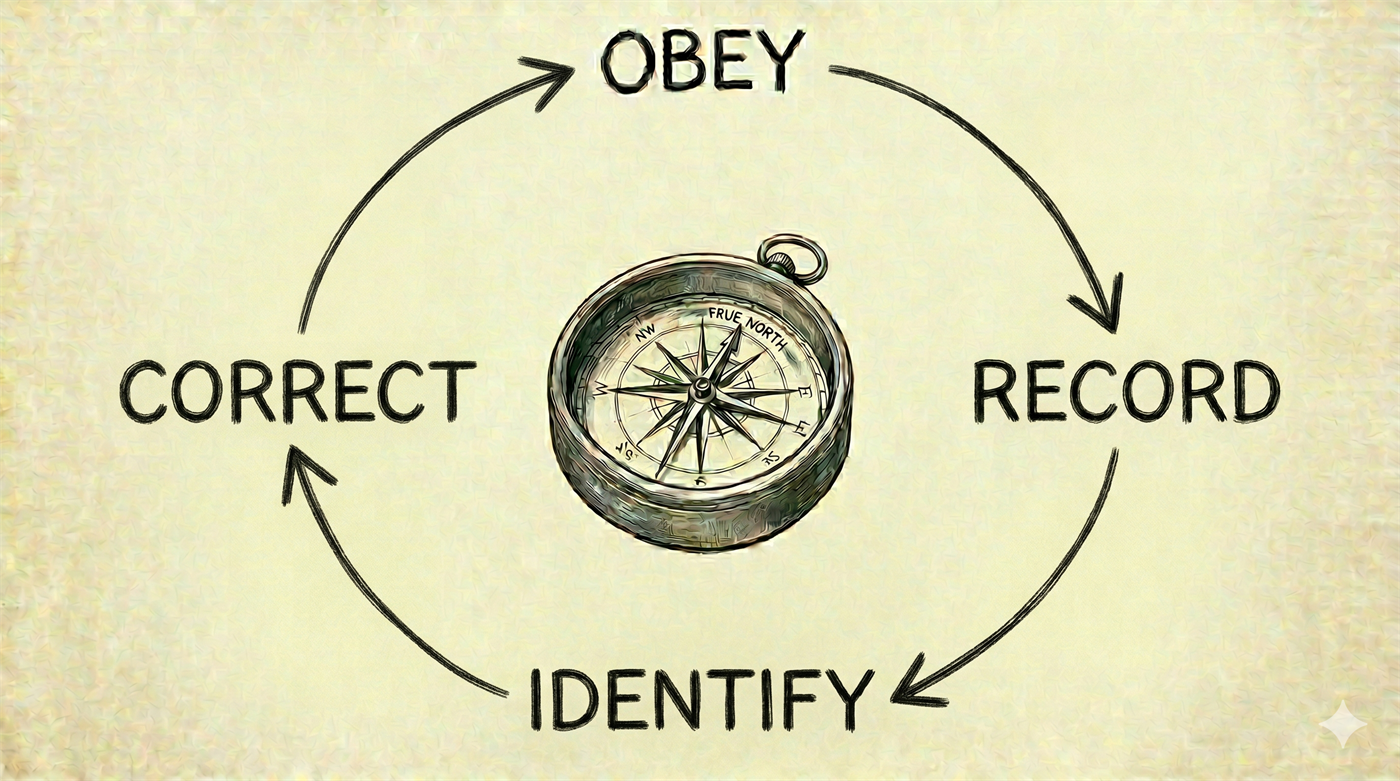
The daily practice is four bearings, run as a loop rather than a ladder.
- 1. Follow by obeying. Accomplish one clear act of obedience today, not a plan but a step.
- 2. Log what you hear and what surfaces. Write down what you heard from others and what the Holy Spirit is showing you, because memory edits.
- 3. Identify the current wobble. Acknowledge the tension you are in, honestly, before it becomes drift.
- 4. Course correct. Close the loop at the end of the day and re-set the heading at the end of the week. Use small turns of the rudder to stay on His course.
That is the instrument and takes ten minutes to instill and use the four bearings. It does not matter what your log is made of. A paper notebook is entirely sufficient, so is a notes app, a folder of plain documents, or a voice memo you will actually listen to. The instrument is a tool and not the practice.
What it asks, and what it does not
It requires for daily, not big, honesty about where you actually are, which is harder than it sounds and is where most people stop. You should also identify one or two others who know your wobble by name and are allowed to ask about it. You do not need to be remarkable, radical, impressive or intense. Those are things that we often desire but burn like chaff. The Holy Spirit does the forming and He fills the sails. My job, and yours also, is to hold the rudder and make small corrections across decades, in the middle of ordinary years where nearly all of the formation into authentic Christ follower actually happens.
The invitation
If any of this lands, the next move is not to study it. It is to run one loop tomorrow and see what it shows you. Then find one or two people to run it with. Accountability is the part I am still working on myself, and is, undoubtedly, one of the most important and impactful elements of this journey.